We are asked to read and review the essay which was available online at
https://macaulay.cuny.edu/eportfolios/lklichfall13t/files/2013/09/Krauss.pdf
The essay was first printed and published in 1982 in Art Journal, Vol. 42
The essay starts with an analysis of two images of Tufa Dome, Pyramid Lake, comparing two contrasting images of the same space. The photograph by O’Sullivan (1868) is described by Krauss as mysterious, hallucinatory, abstract, as the image shows the rocks as undifferentiated, the water and sky connect in a seamless mist which disconnects the rocks from reality and makes them float, no longer held to material space rather that they are alone in the vague luminosity leaving the viewer alone and left to interpret what is in the background and what is or is not there.
Krauss then proceeds to describe the second image which is a lithograph print of O’Sullivan’s “Tufa Dome” published in a scientific journal, using such terms and expressions as: explained, definitive shape, detail, massed, gravity and direction restored, as we can see the foreground and background are clearly defined in the lithograph, the rocks cast shadows and their detail defined in the contrasts.
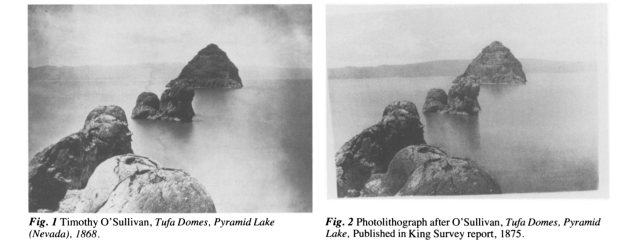
Comparing the photograph to the lithograph, Krauss points out the ‘demotion from strange to commonplace’, she attributes this change to the distinctly different ‘domains of culture’ that these images belonged to and the differences in the ‘expectations in the user of the image.’ The photograph can be seen to be closer to art while the lithograph is more of a scientific document.
Krauss then goes on to question the reasoning behind the origin of O’Sullivan’s photograph. Did O’Sullivan want to create an image intended for geographical/topological research or was he aiming to create an image intended for interpretation and discourse. It also asks where does the final photograph stand, is it art? Certainly, in the nineteenth century landscapes were being increasingly displayed in galleries and the drive for commissioned landscapes helped to push the landscape into the modern aesthetic as more and more artists interpreted and displayed the world around them as they saw it.
Sullivan’s image is reminiscent of an image from fellow war photographer Roger Fenton. O’Sullivan like Fenton captured images from the battlefield, O’Sullivan show his competence and skill in “The battle of Gettysburg” where he is able to frame and capture a landscape of destruction. It is a much closer and tighter frame than Fenton’s “Valley of Death”.
Tufa Dome may have been influenced by Fenton’s Crimean War work as there are reflections of “Sebastapol from the redoubt des Anglais” each image has a clear foreground which stretches off into an unclear distance where the horizon is difficult to see or define, both images achieve a dreamlike state through this effect.
Krauss then asks about the purpose of the gallery wall as a ‘space of exhibition’; the gallery space to provide a display, the ground of criticism, and the explicit inclusion or exclusion of an image on the gallery wall ’ and the resulting influence on the gallery aesthetic where the exhibition wall becomes a representation of ‘exhibitionality,’ and once a painting or photograph is displayed for exhibition in any shape, or form then it is considered as being art by both the gallery and the people who view the image or images. This then asks the question on the purpose of the gallery wall and who decides what is shown in these spaces.
Krauss points out that there is always a requirement for discourse on discursive spaces in photography, due to the need for different subject matter and where these images are presented and the differing aspects to the display of a single image in of their diverse forms, dependent on the type of display and audience. Krauss however appears to be focussed only on painting and that the gallery space can be filled with other objects; from sculptures to large installations and she does not define their place in the discursive space. So again, while I agree that there is an element of inclusivity on the gallery space, it is not merely a device from which to display the value of the exhibition.
Krauss mentions the other end of the artists collection which is the personal collection which has been created over time. Krauss focussed on Atget and his “Paris” photographs, through the “Old France” exhibition at the MOMA in 1985. Her essay then goes on to ask if his collection of images held within his own filling system could be viewed as his Oeuvre and that his collection is unstable and unfocussed. I believe that Atget was a continuous learner and that he shot and reshot “views” as he came to understand how the process worked and how that it could be influenced by previous artwork. Atget is an artist as his thinking and processing work can be seen in his collection; most of which was for his own personal view. He may have been too modest to gather his “best work” for display. Only through time can our view now and the view of curators can we see his work. Krauss article is based on only one quarter of the images display at the MOMA exhibition; they went onto show three more exhibitions of Atget’s work, means that Krauss had based her views on only a part of what could be seen and that Krauss had sped ahead of the museums curators and that she had not made a complete consideration of the complete work. As Papageorge pointed out in “core Curriculum” Krauss did not wait for the collection to play out and that meant that Krauss was unwilling to consider photography as Art per say.
Krauss does make a good point about exclusivity and how certain styles can be pushed to the forefront due to their popularity within the gallery and outside the gallery by what people commission. I disagree with Krauss regarding photography as Art, from its inception Photography has been intertwined with art, both as a guide for later paintings but also allowing Artist to experiment with composition quicker and if many differing styles.
Macaulay.cuny.edu. (1982). Photography’s Discursive Spaces: Landscape/View. [online] Available at: https://macaulay.cuny.edu/eportfolios/lklichfall13t/files/2013/09/Krauss.pdf [Accessed 15 Feb. 2018].
Gordon, S. (2017). Shadows of war. 1st ed. Berkshire: The Royal Collection Trust, pp.164-165.
Papageorge, T. (2011). Core curriculum. New York: Aperture. pp12-29

 Leonard Scott Landscape